
The tryout evaluation rubric.9 drills, 41 skills, 1 to 5.
A youth baseball and softball tryout rubric you can print or score from: every drill and skill with what to look for, what each number from 1 to 5 means, where a stopwatch or radar gun gives you a number instead, and how to run the day so three coaches score the same thing.
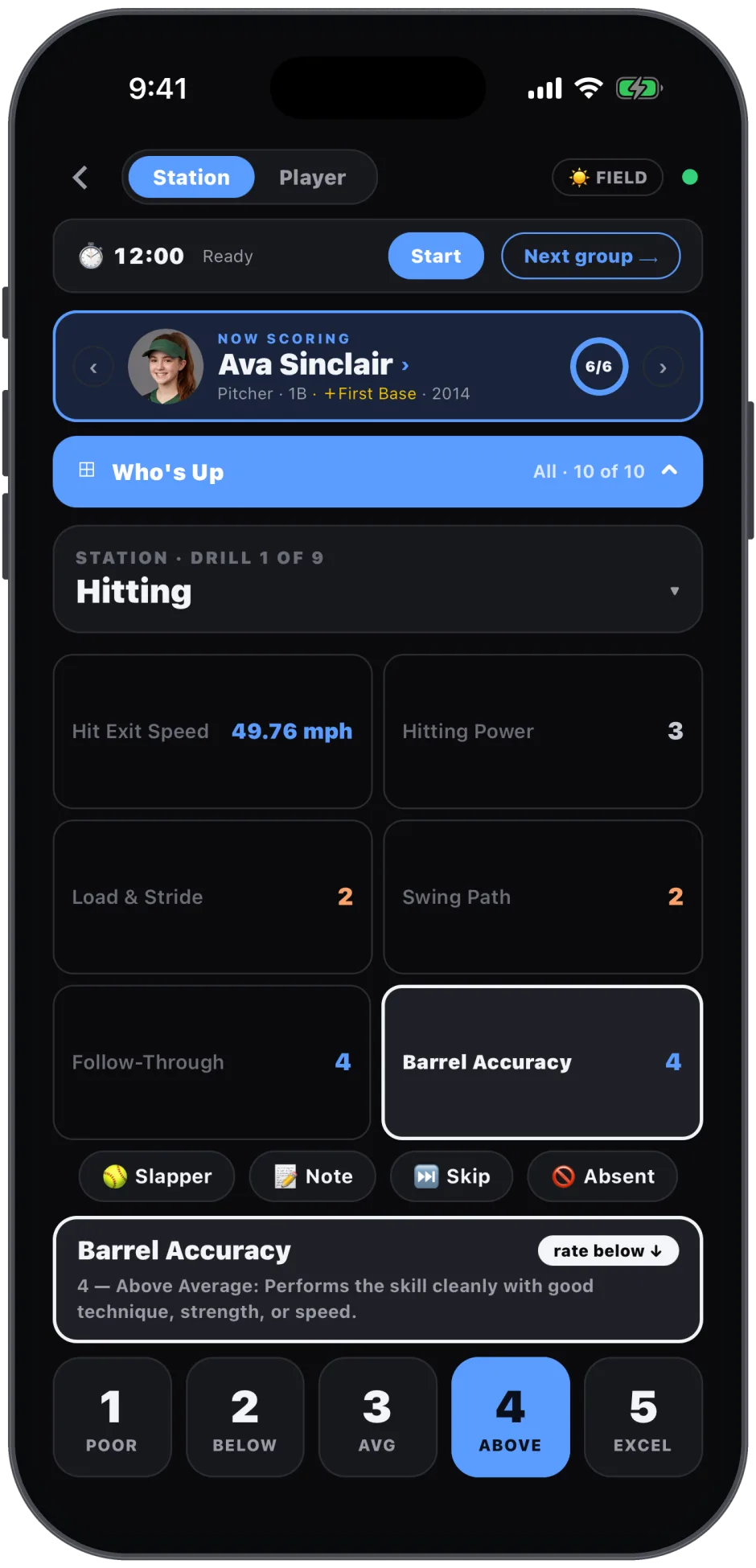
What 1 to 5 means, written down.
A number is only useful if every coach means the same thing by it. Agree on these before the first player steps in, read them aloud at the pre-tryout huddle, and score the skill you saw, not the player you expected.
| Score | What it means |
|---|---|
| 5 | Does it right every time, at game speed, against the group’s best. The player you build the drill around. |
| 4 | Does it right most of the time; the misses are speed or pressure, not technique. |
| 3 | Can do it; does it right about half the time. The middle of a typical group. |
| 2 | Knows what it should look like; rarely gets there yet. Coachable with reps. |
| 1 | Has not learned the skill. Start from the beginning. |
General coaching guidance. In Athlio the same five-point pad scores every skill below, with a cue under each one.
Nine drills. Forty-one skills.
What to score at each station. Timed and measured skills take a number (seconds or mph) instead of, or alongside, the 1 to 5. Position drills are for players trying out at that position.
| Drill | Skills scored | Measured | Who |
|---|---|---|---|
| Hitting | Hit Exit Speed · Hitting Power · Load & Stride · Swing Path · Follow-Through · Barrel Accuracy · Slap hitters also: Slap Hitting · Footwork · Placement | Hit Exit Speed (mph) | Everyone |
| Fielding: Infield | Footwork · Glove Work · Soft Hands · Transfers · Pop Up Tracking · Arm Strength · Throwing Accuracy | Rating only | Everyone |
| Fielding: Outfield | Fly Ball Routes · Fly Ball Tracking · Ground Balls · Arm Strength To 2nd Base · Arm Strength To Home · Throwing Accuracy | Rating only | Everyone |
| Fielding: Overhand Velocity | Overhand Velocity | Overhand Velocity (mph) | Everyone |
| Speed & Agility | Home To 1st Base · 1st To 3rd Base · 5-10-5 Shuttle · Effort | Home To 1st Base (sec), 1st To 3rd Base (sec), 5-10-5 Shuttle (sec) | Everyone |
| Game IQ (Scrimmage) | Reads The Play · Talks · Positioning · Energy · Teammate · Coachable | Rating only | Everyone |
| Pitching Evaluation | Velocity · Control · Rise Ball · Drop Ball · Change-Up | Velocity (mph) | Pitchers |
| Catching Evaluation | Receiving · Blocking · Pop Time | Pop Time (sec) | Catchers |
| First Base Evaluation | Stretch · Scooping · Arm Strength | Rating only | First Bases |
This is the drill catalog Athlio: Dugout scores with. A quick-look tryout uses Hitting, Fielding: Infield, Speed & Agility and the Game IQ scrimmage.
How to run a tryout three coaches can score.
Before. Collect sign-ups ahead of time with the player’s age, positions, bats and throws, so groups can be built before anyone arrives. Decide which drills you will run and which coach owns each station. Agree on the scale above.
Check in. Number every player and split them into groups of six to eight. Groups rotate through stations on a clock; a station that runs long costs every station after it.
Score. One coach per station scores everyone who comes through it. Score each skill right after the rep, before the next player, and do not go back to change a number because of a later rep. Take timed and measured skills as numbers, not impressions. A missed station is a blank, never a 3.
Decide. Total the skills, rank the group, then look at position ranks for the spots you are actually filling. Offer, call back or cut, and write the decision down before anyone calls a parent.
Tell the families. Every family hears the decision, the same day if you can. Give each player their own scores against the group average and two or three skills to work on. Never share the ranking or another player’s numbers.
In Athlio the same day runs as Sign Ups, Check in, Score and the Decision Board: sign-ups from one web link, groups and a walk-up QR at check-in, a scoring console each coach runs from their own phone, averaged scores ranked on the board, and the decision and a progress report emailed to every family at once.
Rubric questions coaches ask.
Why a 1 to 5 scale and not 1 to 10?
Five levels are as fine as a coach can judge from one rep in the sun. With ten, two coaches scoring the same swing land two or three points apart and the ranking becomes noise. Five keeps scores comparable across coaches and across windows, and the written meaning of each number keeps them honest.
How many drills should a tryout have?
Enough to see every player hit, field, throw and run, and the position drills for players trying out at pitcher, catcher or first base. Four stations (hitting, infield, speed and agility, a scrimmage) cover a quick look in about two hours; the full nine take a longer day or a second session.
Should every coach score every player?
Ideally each station has one coach who scores everyone who comes through it; the ranking then averages across stations, not across coaches’ different scales. Where two coaches score the same station, agree on the cues first and compare a few players aloud before the real scoring starts.
What do I tell parents afterwards?
The decision, and if you can, the player’s own scores against the group average and what to work on. Never the ranking or another player’s numbers. A report in plain words beats a phone call that has to be repeated twelve times.
Is this rubric the one Athlio uses?
Yes. The drills, skills, metrics and position rules in the table are the catalog Athlio: Dugout scores with at tryouts and team evaluations. The scale meanings and the how-to are general coaching guidance you can use with a clipboard, a spreadsheet or the app.
Score it in the app.
Score it from the field.
Free to start. iPhone, iPad and Android.